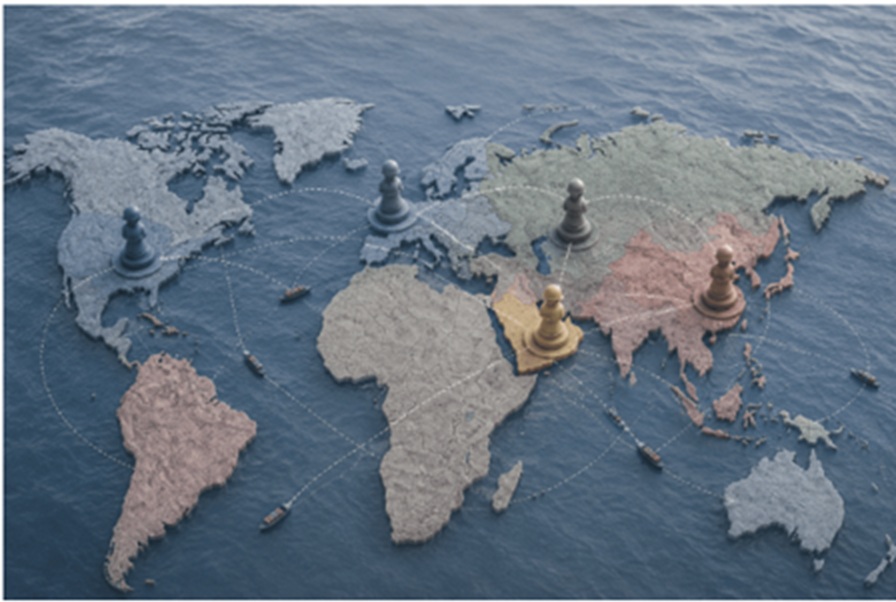
The conflict involving the United States and Iran has rapidly evolved from a regional military confrontation into a development with potentially global consequences. What initially appeared to be a limited military campaign is increasingly being viewed by analysts as a turning point that could reshape international security, economic systems, and geopolitical alliances.
At the center of the debate lies a critical question: If the United States were to expand its military involvement into a full-scale ground invasion of Iran, what would be the likely consequences—not only for the Middle East, but for the entire world?
The Challenge of Invading Iran
Iran presents one of the most difficult military environments for any invading force. Covering an area roughly four times the size of Iraq and home to approximately 90 million people, the country is protected by formidable geography.
The Zagros Mountains dominate western Iran, creating ideal conditions for defensive warfare and guerrilla tactics. Vast deserts stretch across the east, while southern access routes from the Persian Gulf also involve difficult terrain and long supply lines. Any invading army would face significant logistical challenges before even reaching major population centers such as Tehran.
Military analysts have long argued that occupying and stabilizing a country of Iran’s size would require enormous troop commitments. Iran has reportedly spent decades preparing for the possibility of foreign invasion through underground facilities, dispersed missile networks, drone capabilities, and defensive infrastructure designed specifically to target supply lines and armored movements.
Beyond the Battlefield: Economic Consequences
A wider war involving Iran would extend far beyond military considerations.
One of the greatest concerns is the Strait of Hormuz, a narrow waterway through which a substantial portion of the world’s oil supply passes. Any disruption to shipping in this corridor could send energy prices soaring.
Higher oil prices would inevitably affect transportation costs, manufacturing, agriculture, and global inflation. Fertilizers, food production, and semiconductor supply chains could also experience significant disruptions.
Economists have warned that prolonged instability could revive conditions similar to the stagflation experienced during the 1970s—characterized by rising prices combined with slowing economic growth.
The consequences would not be limited to the Middle East. Europe could face renewed energy insecurity, China could confront rising import costs and weaker export demand, and emerging economies could struggle with higher food and fuel prices.
The “Fortress North America” Theory
Some geopolitical commentators have proposed a controversial interpretation of recent events.
According to this theory, certain American policymakers may increasingly view the existing global order as unsustainable. Rather than preserving an expensive system in which the United States guarantees global security and open trade routes, they argue that America should prioritize self-sufficiency.
This vision imagines North America as a resource-rich economic fortress built around domestic production, secure supply chains, energy independence, and strategic control over critical resources.
The argument suggests that in a fragmented world marked by disrupted globalization, countries rich in food, energy, water, and natural resources could emerge stronger than those dependent on international supply networks.
Supporters of this perspective believe that future power will depend less on financial dominance and more on control over tangible resources.
However, critics argue that deliberately accelerating the collapse of existing systems would be extraordinarily risky and could produce consequences far beyond anyone’s ability to control.
Lessons from Russia and Geopolitical Thought
Observers have also drawn parallels with Russia’s experience in Ukraine.
Despite severe sanctions and international isolation, Russia reorganized large portions of its economy toward wartime production. This has led some analysts to argue that prolonged crises can sometimes accelerate industrial transformation.
Others reference the work of Russian geopolitical thinkers such as Alexander Dugin, who argued that the liberal international order would eventually weaken under internal pressures and that nations should prepare for a more fragmented world defined by civilizational identities and strategic self-reliance.
Whether such ideas influence contemporary policymakers remains open to debate. Nevertheless, they have become part of broader discussions about the future of global power structures.
Human Costs: The Forgotten Reality
Amid strategic theories and geopolitical calculations, the greatest burden of war almost always falls on ordinary people.
Iranian civilians face the dangers of bombing campaigns, displacement, and economic hardship. American service members bear the risks of combat and prolonged deployments. Families across the world suffer from rising food prices, inflation, and uncertainty.
Developing nations, many of which have little influence over major geopolitical decisions, are often among the hardest hit by disruptions in energy and commodity markets.
History repeatedly demonstrates that while powerful states pursue strategic objectives, it is ordinary citizens who pay the highest price.
Possible Scenarios Ahead
If the conflict expands further, several outcomes remain possible:
Scenario One:
A prolonged and costly conflict weakens America’s traditional role as a global security guarantor while accelerating the fragmentation of the international order.
Scenario Two:
Extended instability drives countries toward greater regional self-sufficiency, resulting in the emergence of competing economic blocs centered around resource security.
Scenario Three :
Diplomatic efforts eventually prevail, preventing broader escalation while exposing vulnerabilities in the current global system and prompting major strategic reforms.
Conclusion
The future of the Iran conflict remains uncertain. Whether viewed as a consequence of miscalculation, strategic competition, or a symptom of deeper transformations in the international order, its implications are profound.
What is clear is that the world is entering a period of heightened geopolitical uncertainty. Questions about energy security, economic resilience, military commitments, and national priorities are likely to define international politics for years to come.
The most important issue may not be determining whether leaders are reckless or visionary. Instead, it is understanding how their decisions shape the lives of millions of ordinary people whose futures depend on choices made far beyond their control.
As analysts and citizens alike attempt to interpret these events, one principle remains essential: to question assumptions, examine evidence critically, and remember the human consequences behind every geopolitical strategy.